
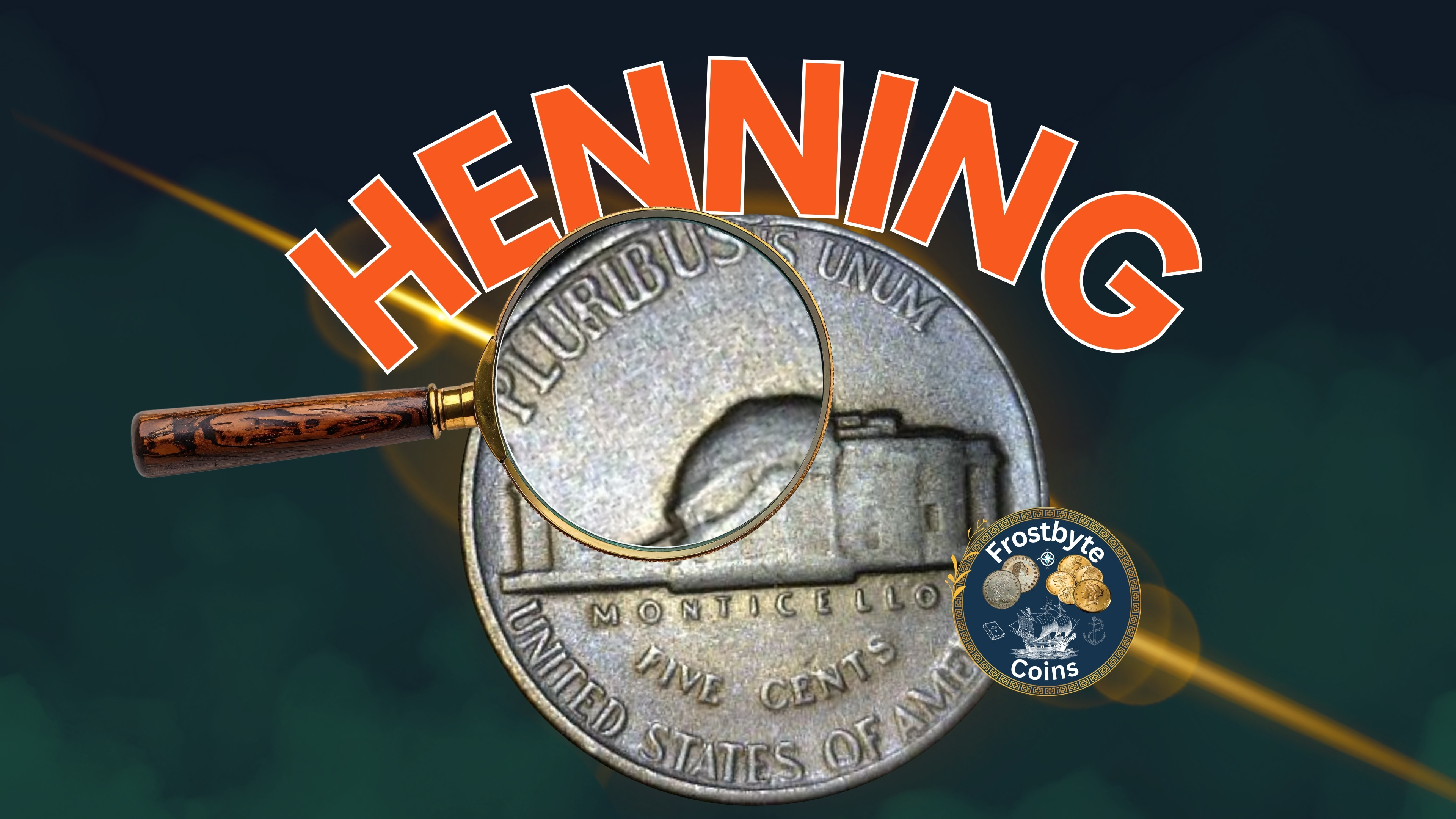
Who Was Francis LeRoy Henning?
Henning was a skilled machinist from Erial, New Jersey, near Camden. He had been arrested for counterfeiting paper money years before. In 1954 he set up a machine shop and struck hundreds of thousands of fake Jefferson nickels. The judge at his sentencing told him, “You wasted tremendous talent.”
October 1954: New Jersey collector Harmon K. Rodgers reports fake 1944 nickels to the Secret Service.
December 1954: A teller at the Pennsauken National Bank turns in $2.40 in fake nickels.
1955: Collectors send samples dated 1944, 1946 and 1947 to the Philadelphia Mint. The Mint’s tests find them “overweight and slightly oversize.”
May 23, 1955: Secret Service agents visit a Camden coin club meeting, and the story hits the newspapers.
1955: Henning flees to Cleveland, Ohio, and dumps his remaining nickels in the Cooper River near Haddonfield, NJ (some accounts say Cooper Creek).
August 1955: A worker cleaning out his empty building finds metalworking machines and about 67,000 nickel blanks.
October 28, 1955: Henning, age 64, is booked in Cleveland.
December 29, 1955: He pleads guilty to counterfeiting nickels.
January 20, 1956: He is sentenced to 3 years in prison and a $5,000 fine, plus 3 more years for counterfeiting $5 bills in Cleveland.
1956: The Philadelphia Mint melts the seized blanks, corrects the alloy, and turns the metal into real nickels.
The Metal
| Henning Counterfeit | Regular Nickel | Wartime Nickel (1942–1945) | |
|---|---|---|---|
| Copper | about 79.1% | 75% | 56% |
| Nickel | about 20.5% | 25% | 0% |
| Silver | 0% | 0% | 35% |
| Manganese | 0% | 0% | 9% |
| Iron | about 0.4% | 0% | 0% |
| Weight | Varies, often over 5.0 g | 5.0 g | 5.0 g |
Henning struck his coins on a copper-nickel alloy of about 79% copper and 20% nickel. Many articles call it ‘Monel metal,’ but that label is wrong: real Monel is about two-thirds nickel. Some accounts say he bought his blanks from the same supplier as the U.S. Mint for about 3½ cents each. That claim doesn’t hold up well. In the 1950s the Mint made its own blanks, and Henning’s alloy doesn’t match the Mint’s. He most likely ordered his blanks from a commercial metal supplier.
Dates He Made
Henning’s nickels are known dated 1939, 1944, 1946, 1947 and 1953. From rarest to most common: 1953, 1946, 1947, 1939, and the 1944 “No P.” None carry a mintmark. Henning told investigators he made six pairs of dies, so a sixth date may still be out there. Researchers are still sorting out how many reverse dies he used. Henning specialist Joe Cronin has documented reverse dies that weren’t known before.
How to Spot a Henning
- A 1944 with no large mintmark above Monticello. Every real 1944 nickel has a large P, D or S there.
- No silver. A real 1944 nickel is 35% silver; a Henning has none.
- Many show a marker on the R in PLURIBUS (a “looped R” or a dot), but not all do.
- Many weigh more than 5.0 grams, but not all. Weight alone can’t confirm or rule out a Henning.
- Any date he copied (1939, 1946, 1947, 1953) with the same die markers.
If you think you’ve found one, have it checked by an expert or a grading service that attributes Henning counterfeits.
Case Study - 1953-P Joe Cronin
A 1953 nickel that collector Lee Mansfield found in a $100 bag of nickels was reviewed by Henning specialist Joe Cronin, who confirmed it as a Henning counterfeit and documented a new die marker on it. The 1953 is now considered the rarest Henning date, followed by the 1946, 1947, 1939, and the more common 1944 “No P.” Like his other fakes, it fits Henning’s metal, which runs about 79% copper and 20% nickel instead of the Mint’s 75/25. Cronin has since published what collectors call the definitive book on the Henning counterfeits.
Sources & Further Reading
- Dwight H. Stuckey, The Counterfeit 1944 Jefferson Nickel (1982)
- Joe Cronin, The Henning Nickels Collectors’ Guide (2024)
- David W. Lange, “USA Coin Album: An Infamous Anniversary,” NGC — ngccoin.com
- “Stalking the Cooper River for thousands of fake nickels,” Philadelphia Inquirer, 2012 — inquirer.com
- The E-Sylum, Numismatic Bibliomania Society — coinbooks.org
- “1953 Henning Nickel Confirmed and New Die Marker,” CoinTalk — cointalk.com
Have research or a correction? Contact FrostbyteCoins.
Legal aftermath
The U.S. Secret Service traced Henning through his output and arrested him in 1955. He was convicted of counterfeiting and sentenced to prison. Agents recovered and destroyed large quantities of his fakes, but enough had already entered circulation that Henning nickels still turn up in change, rolls and collections today — which is why the diagnostics remain worth knowing.
Cultural significance
The Henning nickel is one of the most famous modern U.S. counterfeits precisely because it broke the usual rule that counterfeiters target high-value coinage. It is a standing reminder that authentication is about how a coin was made, not just what it claims to be. For collectors, a documented Henning fake is also collectible in its own right — a piece of numismatic history rather than something to spend.