
Annealing
Minting ProcessThe process of heating planchets to soften the metal before striking, making it more receptive to receiving the design.
Essential terminology and myth-busting for collectors of all levels.
Every hobby has its own language, and coin collecting is no exception. Whether you're a beginner picking up your first coin or an experienced collector digging into advanced numismatics, this glossary is your reference. We explain the terms that actually matter — obverse, reverse, planchet, strike, mintage, relief, and dozens more — in plain language. No jargon for the sake of jargon, no assumed knowledge. If you hear a term in one of our videos or in conversation with another collector and want it defined clearly, start here. Bookmark this page. You're going to need it.
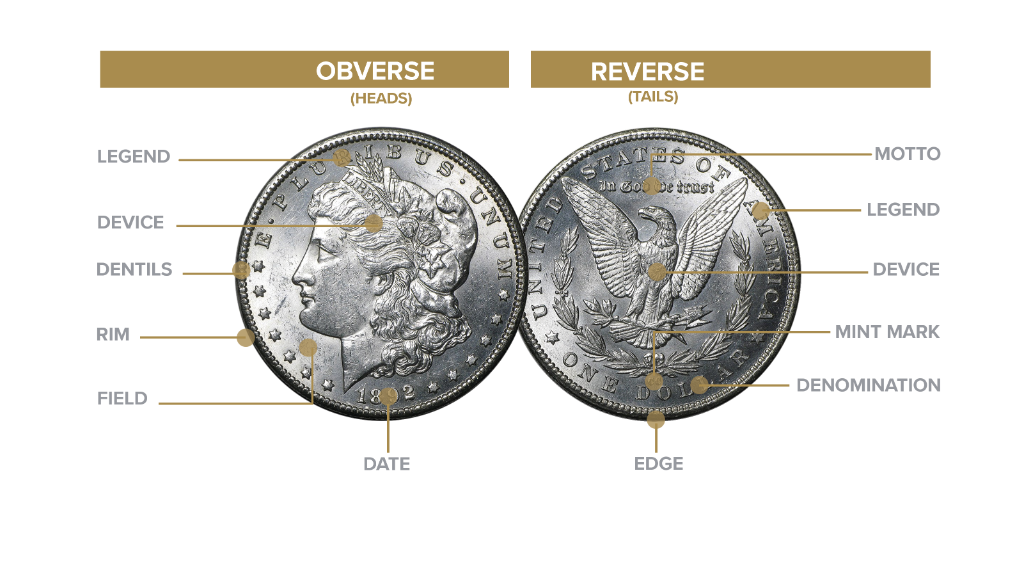
Visual reference for common numismatic terms
The process of heating planchets to soften the metal before striking, making it more receptive to receiving the design.
Color applied to a coin through chemical or heat treatment to mimic natural toning. Grading services will not grade AT coins.
A coin struck without the retaining collar in place, causing the metal to spread outward beyond normal diameter.
A coin struck for general circulation, as opposed to a proof or special issue.
Certified Acceptance Corporation — an independent service that evaluates graded coins for quality, adding a green sticker to those meeting their strict standards.
A coin that shows signs of wear from being used in everyday commerce.
The act of polishing, dipping, or otherwise altering a coin's surface. Cleaning almost always reduces numismatic value.
A coin struck on a planchet that is missing a curved segment due to a blanking error, creating a crescent-shaped clip.
A raised, blob-like area on a coin where a piece of the die has broken away and metal has filled the void.
A grade assigned to a coin that is genuine but has problems (cleaning, damage, etc.); notes the problem rather than giving a straight numerical grade.
The principal design element — the portrait, figure, or symbol — on a coin.
A hardened steel stamp engraved with the coin's design, used to strike the planchet.
A raised line on a coin caused by metal flowing into a crack in the die during striking.
A coin struck from a die that was hubbed with a misaligned or doubled impression, resulting in visible doubling of design elements. Note: it's "doubled die," not "double die."
The flat, background portion of a coin's surface not used for the design or inscriptions.
The purity of precious metal in a coin, expressed as a decimal (e.g., .900 for 90% gold).
A master die used to create working dies, transferring the design from the original engraving to multiple production dies.
The scarcest and most valuable date within a coin series, often the hardest to obtain for collectors completing a set.
The main inscription running around the circumference of a coin (e.g., "UNITED STATES OF AMERICA").
The shimmering, cartwheel-like light effect on uncirculated coins, caused by the microscopic flow lines created during striking.
The intrinsic value of the metal in a coin, based on current spot price, regardless of numismatic value.
A coin showing no wear from circulation. MS coins are graded MS-60 through MS-70 on the Sheldon scale.
The total number of coins produced for a particular date and mintmark combination.
A small letter indicating which mint facility produced the coin (e.g., "D" for Denver, "S" for San Francisco).
A secondary inscription, such as "IN GOD WE TRUST" or "E PLURIBUS UNUM."
An extremely rare error coin struck with mismatched obverse and reverse dies that were never intended to be paired.
The front ("heads") side of a coin, typically bearing the principal portrait or design.
A coin struck with the planchet not properly centered between the dies, resulting in part of the design missing.
The blank metal disc upon which the coin design is stamped. Also called a "blank" before the rim is formed.
A tally maintained by grading services showing how many coins of a specific date, mintmark, and grade have been certified.
A specially made coin struck multiple times on polished planchets with polished dies, producing sharp detail and a mirror-like surface. Not a grade — a manufacturing method.
Greenish residue or damage caused by plasticizers leaching from certain plastic coin holders onto the coin surface.
The vertical grooves or ridges on the edge of certain coins, originally intended to prevent clipping of precious metal.
A mintmark that was punched into the die more than once, typically at slightly different angles or positions.
The back ("tails") side of a coin.
The raised border around the outer edge of a coin that protects the design from wear.
A date that is scarce but not the rarest in a series; still carries a premium over common dates.
The 70-point numerical grading scale (1–70) originated by Dr. William Sheldon for large cents and now used for all U.S. coins.
The sealed, tamper-evident plastic holder used by grading services (PCGS, NGC, etc.) to encapsulate and certify a graded coin.
The act of the dies impressing the design onto the planchet under pressure.
Natural coloration that develops on a coin's surface over time due to chemical reaction with the environment. Natural toning is desirable; artificial toning is not.
A coin that has never been released into general circulation and shows no wear.
The process of forming the raised rim on a planchet before the coin is struck.
A designation system for Morgan and Peace dollar die varieties, named after researchers Leroy Van Allen and A. George Mallis.
Adjectival grades: Good (G), Very Good (VG), Fine (F), Very Fine (VF), Extremely Fine (EF/XF), About Uncirculated (AU) — representing progressively less wear.
A form of mechanical cleaning using a high-speed tool to create artificial luster. Permanently damages the coin.
We use cookies to understand how the site is used and improve your experience. See our Privacy Policy.