Coin Grading Guide
Understanding the Sheldon Scale and how grading varies by denomination and year.
Before you buy or sell a rare coin, you need to know what it's worth — and grading is the foundation of that value. This guide walks you through the Sheldon scale, the difference between circulated and mint state, and the specific details graders look for, from luster to strike to surface marks. We show you how to look at a coin the way a professional would, so you're never guessing in a negotiation. Whether you're deciding whether to submit a coin to a grading service or just trying to understand a price tag, this is the starting point that arms you with the correct information.
The Sheldon Scale Explained
The Sheldon Coin Grading Scale was developed in 1949 by numismatist Dr. William H. Sheldon for early American large cents. It ranks a coin's condition on a numeric scale from 1 (Poor) to 70 (Perfect Mint State), and is now the industry standard used by PCGS, NGC, and CAC.
The scale is divided into three broad tiers: Circulated (grades 1–45), About Uncirculated (50–58), and Uncirculated / Mint State (60–70). Proof coins (designated PR) are separately graded on the same 60–70 numeric range.
A coin's grade directly affects its market value — sometimes by orders of magnitude. A single point difference between MS-64 and MS-65 can double or triple a coin's price for key dates.
Sheldon Scale Grades
| Grade | Name | Tier | Description |
|---|---|---|---|
| P-1 | Poor | Basal State | Barely identifiable. Date and type may be barely readable. Heavily worn, smooth surfaces with no remaining detail. |
| FR-2 | Fair | Basal State | Most of the design is visible but worn nearly flat. The date, mintmark, and major lettering are readable but faint. Rims may be worn into the legend. |
| AG-3 | About Good | Worn | Rim is visible but may touch the lettering in places. Major design elements are outlined but lack interior detail. Date and mintmark are readable. |
| G-4 to G-6 | Good | Heavily Worn | Rim is full or nearly full. Major design elements are visible with significant flattening. Fine details like hair lines and feathering are gone. Date and lettering are clear. |
| VG-8 to VG-10 | Very Good | Worn | Design is worn but major details are clear. Some inner detail is visible on the main device. Rims are full. About half of the wear is present between Good and Fine. |
| F-12 to F-15 | Fine | Moderately Worn | Considerable wear but design elements are sharp in places. Hair lines, feathering, and other mid-level details show separation. Rims are full and lettering is crisp. |
| VF-20 to VF-35 | Very Fine | Lightly Worn | Moderate wear on high points only. Significant detail remains visible. Hair lines, clothing folds, and feather details are clear and defined. Lettering and rims are sharp. |
| EF-40 to EF-45 | Extremely Fine | Light Wear | Light wear visible only on the highest points of the design. Most details are sharp and well-defined. Original mint luster may be partially visible in protected areas. |
| AU-50 to AU-58 | About Uncirculated | Trace Wear | Trace wear on only the highest design points from brief circulation or cabinet friction. Most of the original mint luster is present. Coin appears nearly new to the naked eye. |
| MS-60 to MS-70 | Mint State | Uncirculated | No circulation wear whatsoever. Coins show original mint luster. MS-60 has heavy bag marks and contact; MS-65 has minimal marks; MS-70 is flawless with full luster and no visible imperfections even under magnification. |
| PR-60 to PR-70 | Proof | Uncirculated | Specially struck coins with mirror-like fields and frosted devices (cameo). Made for collectors, not circulation. PR-70 is a perfect proof with no visible marks or hairlines. |
Coin Grading Scale
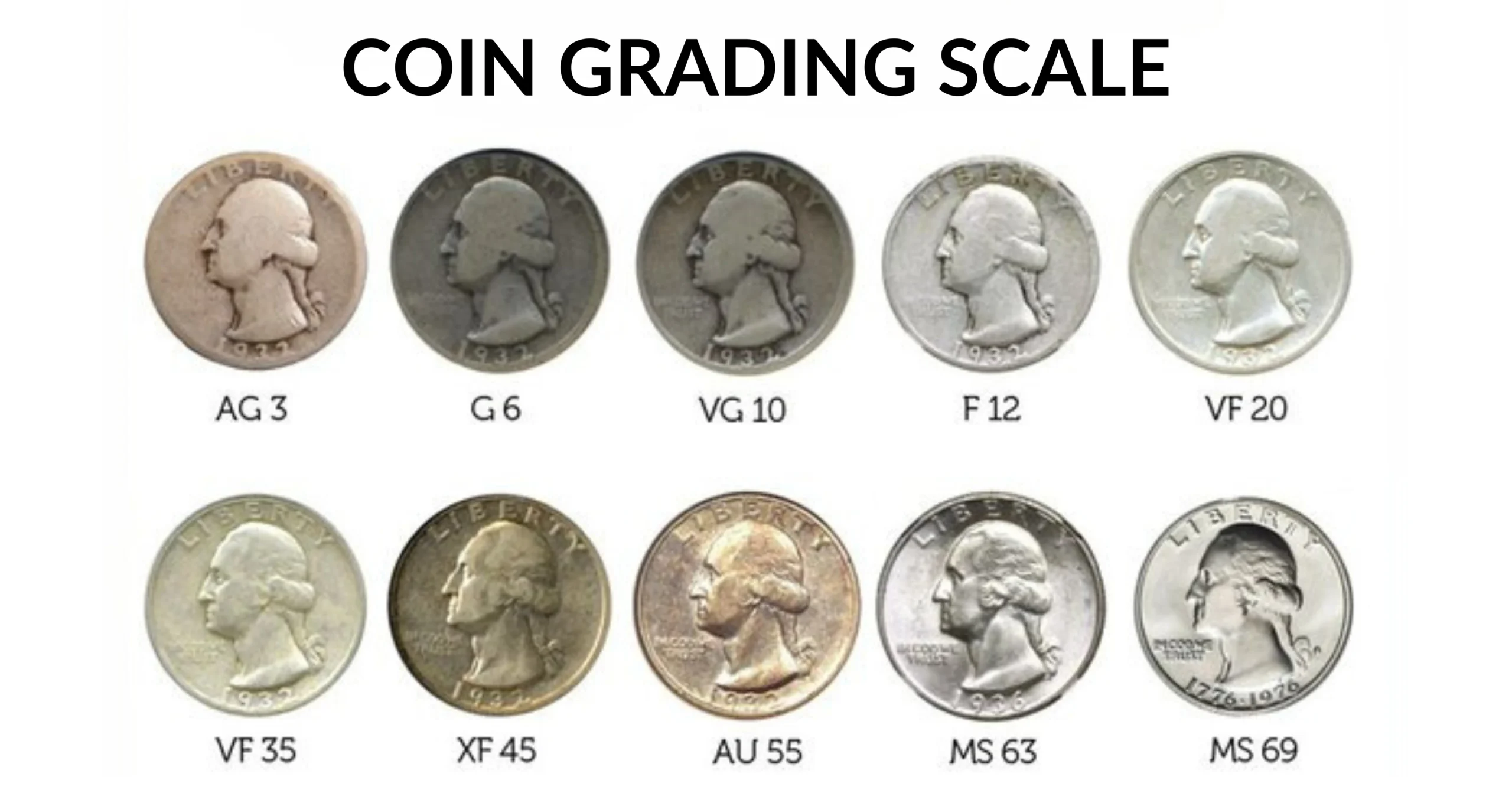
Washington quarters shown at each grade level, from heavily worn AG-3 to near-perfect MS-69. Use this visual progression alongside the Sheldon scale table above to compare your own coin's wear, luster, and strike.
Grading Variations by Denomination & Year
Large Cents & Half Cents (1793–1857)
Grading Focus: Corrosion and planchet issues are common on early copper. Graders look for smooth surfaces, original color (chocolate brown to red-brown), and absence of environmental damage. Even AU examples often show porosity — a key value factor.
Wear Points: Highest points: Liberty's hair above the brow, cheek, and the leaves on the reverse wreath.
Flying Eagle & Indian Head Cents (1856–1909)
Grading Focus: Copper-nickel issues (1856–1864) are harder to find in high grade. Red color (RD) commands a premium over Red-Brown (RB) and Brown (BN). Strike quality varies by date — 1877 is notoriously weak.
Wear Points: Flying Eagle: wing tips and tail feathers. Indian Head: tip of the feather in the headdress and the ribbon ends.
Lincoln Cents (1909–Present)
Grading Focus: Wheat and Memorial reverses have different wear patterns. Copper issues (pre-1982) are judged for color; zinc issues are prone to spotting. The 1909-S VDB and 1914-D are key dates where even Good condition is valuable.
Wear Points: Abe's cheek and jaw, the bowtie, and the wheat stalk tips on the reverse.
Buffalo Nickels (1913–1938)
Grading Focus: Strike quality is critical — many dates (e.g., 1926-S, 1937-D 3-Leg) came weakly struck. Full Horn on the bison is a premium indicator. Mintmarks are on the reverse under FIVE CENTS and wear away quickly.
Wear Points: Indian's cheekbone and braid tip, the bison's horn, shoulder, and tail.
Mercury & Roosevelt Dimes (1916–Present)
Grading Focus: Mercury dimes are judged by split bands on the fasces — Full Split Bands (FSB) carry a significant premium. Silver Roosevelts (pre-1965) are common in high grade; key date 1949-S is rare in uncirculated.
Wear Points: Mercury: wing feathers and face details. Roosevelt: torch flame and the olive branch leaves.
Washington Quarters (1932–Present)
Grading Focus: Pre-1965 silver issues are the primary collectibles. Key dates: 1932-D and 1932-S. The 1937 double die is notable. Clad quarters (1965+) are collected mainly as Proof or error coins.
Wear Points: Washington's cheek and the eagle's breast feathers on the reverse.
Half Dollars (Walking Liberty, Franklin, Kennedy)
Grading Focus: Walking Liberty halves are notoriously difficult to grade — Liberty's hand and gown lines are the benchmark. Franklin halves are judged by Full Bell Lines (FBL) on the reverse. 1964 Kennedy halves in silver are popular.
Wear Points: Walking Liberty: Liberty's extended hand and gown folds. Franklin: the bell crack lines and the lower hair lines.
Morgan & Peace Dollars (1878–1935)
Grading Focus: Morgan dollars are checked for mintmark sharpness and cheek strike. The 1921 Peace dollar is weakly struck by design. VAM varieties (die-pairing differences) are a major collecting niche within Morgan grading.
Wear Points: Morgan: Liberty's ear, hair above the brow, and the eagle's breast. Peace: Liberty's hair radiating lines and the eagle's wing tips.
Gold Coins ($1–$20) (1795–1933)
Grading Focus: Gold is soft and shows wear quickly — even AU examples may have rub on the highest points. Graders look for luster in the fields and the sharpness of Liberty's hair. Skin spots and rim nicks heavily impact value. Counterfeit detection is paramount.
Wear Points: Liberty's hair above the brow, cheek, and the eagle's feathers on the reverse.
Key Grading Terms
The Rarity Scale
Rarity vs. Grade
A coin's grade describes its condition; its rarity describes how many examples are believed to survive today. The two are independent — a worn, low-grade coin can still be extraordinarily rare, while a flawless MS-70 can be quite common.
The PCGS CoinFacts Rarity Scale™ rates rarity from 1.0 (over a million survivors) to 10.0 (a single known specimen). The descriptive tiers below summarize that range in plain language so collectors can gauge how hard a coin is to encounter at any grade.
| Rarity | Tier | What it means |
|---|---|---|
| 10.1 | None Known | No surviving specimen is currently documented anywhere. |
| 10.0 | Unique | Only a single example is known to exist. |
| 9.0–9.9 | Ultra Rare | Just a handful survive — typically fewer than about two dozen coins. |
| 8.0–8.9 | Extremely Rare | Roughly two dozen to perhaps a hundred examples estimated. |
| 7.0–7.9 | Very Rare | On the order of a hundred to a couple hundred survivors. |
| 5.0–6.9 | Rare | Several hundred up to about a thousand known. |
| 3.0–4.9 | Very Scarce | A few thousand up to roughly ten thousand survive. |
| 2.0–2.9 | Scarce | Tens of thousands of examples still exist. |
| 1.1–1.9 | Common | Hundreds of thousands, approaching a million, are available. |
| 1.0 | Very Common | More than a million survivors estimated. |
PCGS Photograde™
The PCGS Photograde tool is an interactive online reference that pairs high-resolution photographs of graded coins side-by-side at every Sheldon scale level. You select a denomination and year, then visually compare your coin's wear, strike, and luster against certified PCGS examples to estimate its grade before submitting.
It covers every major U.S. coin series from half cents through modern issues, with images at 2–3 grade intervals. While it won't replace professional certification, it's an essential first step for self-assessment and learning what distinguishes a G-4 from a VG-8.
Visit PCGS Photograde